52,000 Tech Jobs Erased in Q1 2026. Who Survives?
Block cut 40% of engineers. Oracle axing 30,000. Polymarket: 93% odds layoffs keep rising. The honest survival guide.
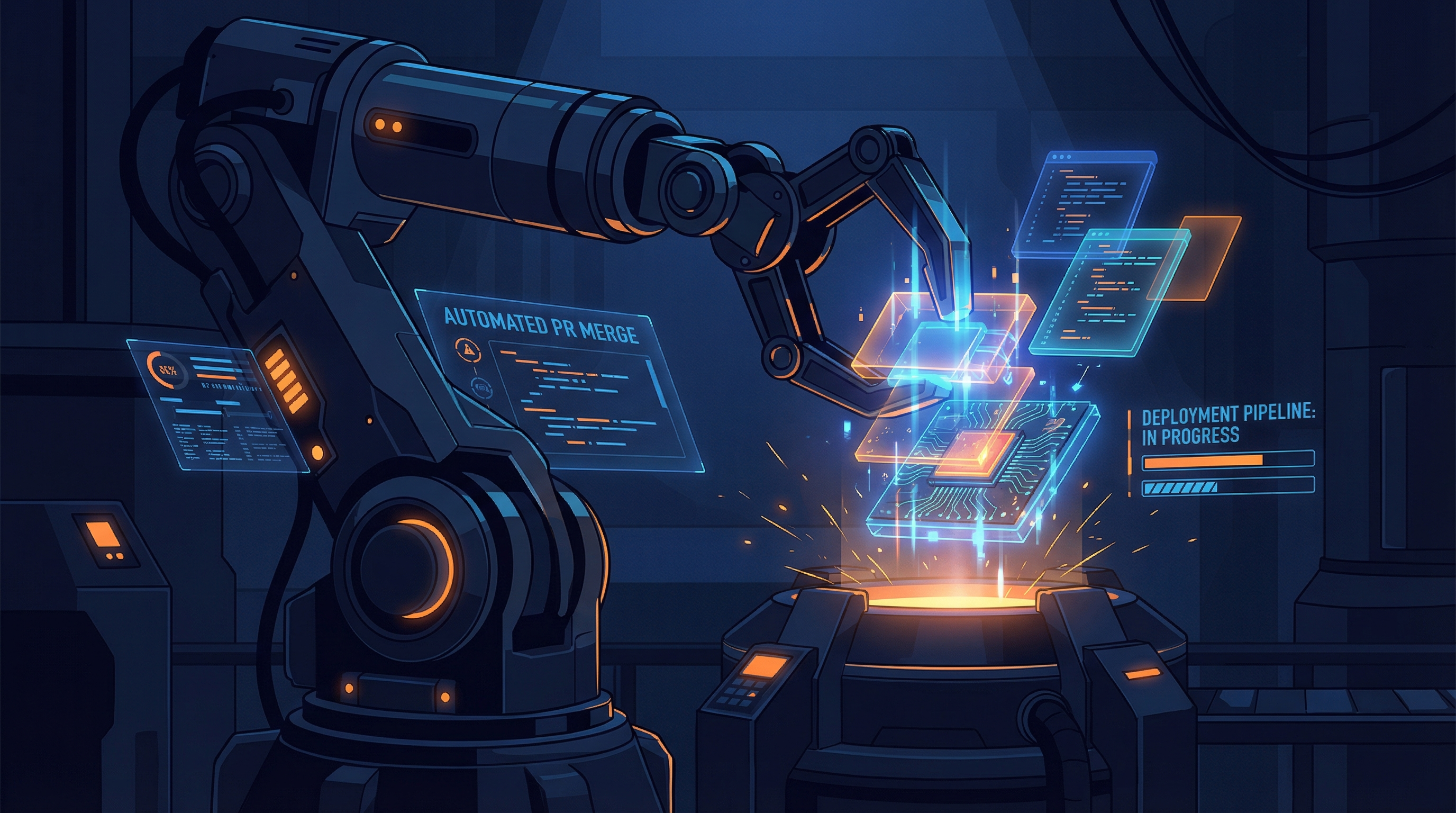
Watch: 52,000 Tech Jobs Erased — Who Actually Survives?
There's a moment in the a16z interview where Owen Jennings, a Block executive, says something that makes you pause: "We are not writing code by hand anymore. That's over."
Not "we're using AI to assist our engineers." Not "we've increased productivity." The correlation between headcount and output at Block — the $50B fintech company formerly known as Square — broke in the first week of December 2025.
And then Oracle announced 30,000 layoffs. Meta followed with sweeping cuts. Atlassian shed 1,600 "ahead of an AI push." By the end of Q1 2026, the Challenger, Gray & Christmas outplacement firm reported 52,050 US tech job cuts — up 40% year-over-year — with AI cited as the reason for 25% of all job cuts across all industries in March.
This is no longer the story of one company experimenting with AI. This is an industry undergoing structural transformation, and it's hitting every level — from junior developers to CEOs. Here's what's actually happening, who survives, and how.
1. The Trigger: Block's "Binary Shift"
Owen Jennings describes a specific inflection point. Not gradual improvement — a discontinuous jump. In the first week of December 2025, two things shipped nearly simultaneously: Anthropic's Opus 4.6 and OpenAI's Codex 5.3.
The critical breakthrough wasn't raw intelligence. It was the ability to work with existing complex codebases — not just greenfield projects. Before December, AI coding tools were impressive on new projects but struggled with the tangled reality of production systems: legacy APIs, undocumented business logic, migration debt, cross-service dependencies.
Opus 4.6 and Codex 5.3 crossed that threshold. Suddenly, AI agents could navigate Block's massive codebase — hundreds of services, years of accumulated complexity — and make meaningful changes that actually passed CI and code review.
Jennings called it a "binary shift." One week the correlation between headcount and output held. The next week, it didn't.
Block's BuilderBot isn't Copilot bolted onto an IDE. It's an autonomous agent that reads Jira tickets, navigates dependencies, writes implementations with tests, self-reviews against anti-patterns, and — for changes within established confidence thresholds — merges its own PRs without human review.
The senior engineers who remain spend their time on the 10-15% that requires deep judgment: edge cases, security-sensitive changes, cross-team architecture decisions, and product trade-offs that require understanding the business, not just the code.
Jack Dorsey didn't mince words in Block's shareholder letter: "Intelligence tools are why we're reducing our workforce." Not restructuring. Not optimizing. Reducing. And after the cuts, he announced Block would operate with just three roles: Individual Contributor, Directly Responsible Individual (DRI), and Player-Coach. The entire middle management coordination layer — gone.
2. Block Is Not Alone: The Wave Is Here
If Block were the only story, you could dismiss it as one CEO's aggressive bet. But the data tells a different story entirely.
Oracle: 30,000 Jobs to Fund AI Data Centers
Oracle is executing its largest-ever layoff wave — up to 30,000 jobs globally across the US, India, Canada, and Mexico. Workers were terminated via 6 AM emails. The cuts are explicitly to fund massive AI data center expansion as part of a $2.1 billion restructuring plan. A company generating $6B+ in quarterly income is cutting humans to buy GPUs.
Meta: Sweeping AI-Driven Restructuring
Reuters reported Meta planning layoffs of 20%+ — more than 12,000 people — as AI infrastructure costs mount. A confirmed March 25 round of ~700 specifically targeted Reality Labs, recruiting, and sales — roles that are predominantly management and coordination functions. Meanwhile, CapEx guidance rose to $115-135B for 2026. The message: we're spending more on AI, less on humans.
Atlassian: 1,600 "Ahead of AI Push"
Atlassian laid off 1,600 workers explicitly framed as preparation for an AI transformation. Reddit's reaction was overwhelmingly skeptical of the framing — 3,300+ upvotes and 532 comments calling it "cost-cutting with AI as cover." Which brings us to a critical question we'll address later: how much of this is genuine AI disruption, and how much is convenient narrative?
The Q1 Numbers Are Staggering
Peter Diamandis captured the structural reality in a tweet that went viral:
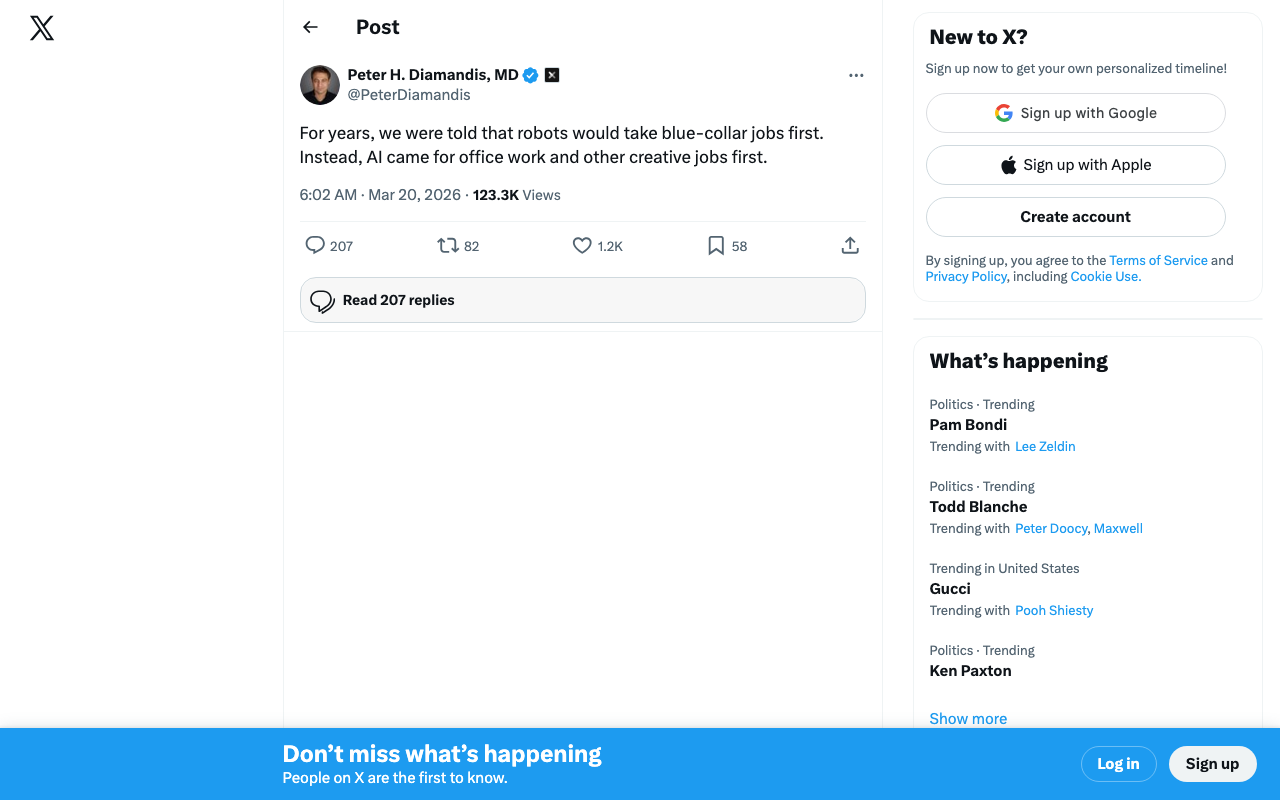
The insight Diamandis has been hammering: "Companies are rewarded by shareholders for cutting people from payroll. We're entering a new phase in which companies will fire people they've never hired. Millions trying to enter the labor market won't be directly laid off — they'll just be locked out."
That last part is the quiet catastrophe nobody's talking about. Layoffs make headlines. The jobs that never get posted don't.
The All-In Podcast hosts — four billionaire tech investors who collectively touch hundreds of companies — reached consensus: Block is the canary in the coal mine, not the exception. David Sacks framed it in unit economics terms: if BuilderBot handles the work of 10 engineers at the cost of compute tokens, the ROI is so overwhelming that not adopting similar tools becomes a fiduciary risk.
3. Every Level Is Being Disrupted
Here's what makes Q1 2026 different from previous "AI will take your job" cycles: this time, the disruption isn't limited to entry-level coding. It's compressing every layer of the knowledge work hierarchy simultaneously.
IC Engineers: The Ground Floor Is Disappearing
Block's BuilderBot is the headline, but the individual contributor disruption runs deeper.
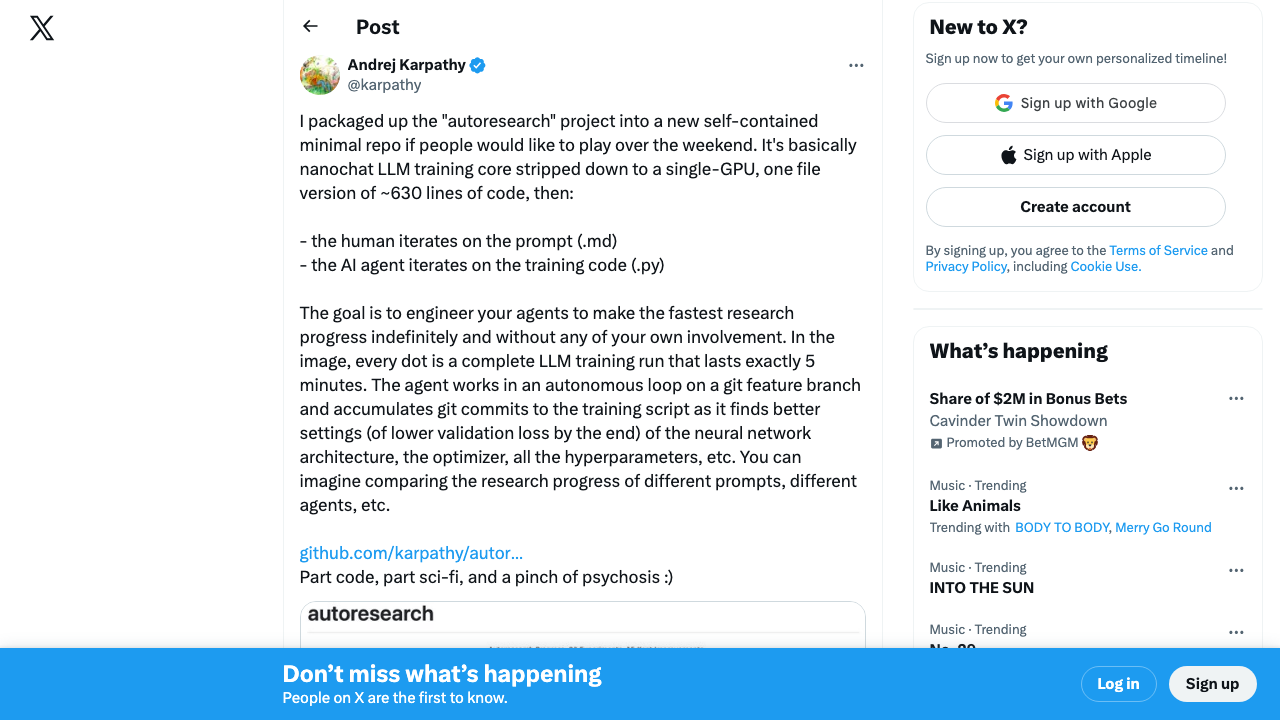
Andrej Karpathy — ex-Tesla AI director, OpenAI co-founder — publicly stated he went from writing 80% of his own code to 0%, now spending 16-hour days directing AI agents instead. He open-sourced an autoresearch framework (~630 lines) that runs 100 ML experiments overnight. "You don't write code," he said. "You write a Markdown program file." The tweet announcing it pulled 16.4K likes and 3.7M views.
The junior developer pipeline is fracturing visibly. Entry-level developer postings are down 34-40% from pre-2022 levels. Companies want seniors who can wield AI tools, not juniors to train. A highly-upvoted r/programming thread (955 upvotes, 266 comments) put it bluntly: "You can't have a healthy senior pipeline in 5 years if you're not growing juniors today."
The Dallas Fed published research confirming the pattern: "AI can both substitute for entry-level workers and complement experienced workers... The current model of white-collar career progression involves doing codifiable tasks while slowly learning tacit knowledge to become an expert — AI destroys this pathway."
M1 Managers: The Coordination Layer Is Collapsing
After cutting 4,000 jobs, Jack Dorsey made a prediction that Forbes turned into a headline: "AI will kill middle management."
He may already be proving it. Block's squad restructure from 14 to 3-4 people didn't just eliminate engineers — it eliminated the entire coordination layer: the standups, the status reports, the Jira grooming, the information routing that managers provided. When an AI agent reads the ticket, writes the code, and merges the PR, who needs a project manager to "align" the team?
Chamath Palihapitiya drove the point home from a different angle: "Our team used Software Factory to rebuild and replace Jira in a little more than a month." A function that previously required PM + engineering coordination + management oversight now requires upfront spec + AI execution. The management coordination layer is collapsing into spec writing.
Directors and VPs: The Org Chart Is Flattening
Going from squads of 14 to 3-4 means eliminating ~3 organizational layers. This isn't just headcount reduction — it's structural org flattening. Anthropic's own research mapped out the threat, and Fortune summarized the finding that startled the industry: "A 'Great Recession for white-collar workers' is absolutely possible."
Senator Elizabeth Warren asked Meta, Amazon, and others a question that generated 9.8K upvotes on Reddit: "If AI makes you more productive, why does that mean fewer humans and more profit rather than better outcomes at the same headcount?"
Nobody had a good answer.
C-Suite: Even the Corner Office Isn't Safe
Mustafa Suleyman (Microsoft AI CEO) made the most aggressive prediction: "AI could wipe out most white-collar jobs within the next 12-18 months."
Dario Amodei (Anthropic CEO): "50% of entry-level white-collar jobs gone in 3 years."
Sam Altman (OpenAI CEO) was more candid than usual, admitting AI is "killing the labor-capital balance" — and that "nobody knows what to do." The Reddit thread hit 4.4K upvotes and 942 comments — the highest comment count in any AI-related thread in March.
And it's not just tech companies. Inc. reported that AI strategic pressure is pushing top executives out of corner offices. The Coca-Cola and Walmart CEO exits both sparked analysis about AI's growing influence on C-suite tenure.
The key insight: This isn't a coding story anymore. It's an every-knowledge-worker story. When junior devs, middle managers, directors, and CEOs are all facing AI pressure simultaneously, the "just upskill" advice rings hollow — because the target keeps moving.
4. The Honest Assessment: What's Really Happening
Every time automation displaces workers, the same reassuring parallels get trotted out. Let's stress-test them honestly.
The ATM Parallel (Reassuring)
ATMs automated cash dispensing in the 1970s. Bank teller employment increased from ~300,000 to ~600,000 by 2010 because cheaper branches led to more branches, and tellers shifted to relationship and sales roles.
Does it map? Partially. If AI makes software dramatically cheaper, demand could explode (Jevons paradox), creating more human roles. Karpathy argues this. But bank tellers shifted from dispensing cash to building relationships — a lateral move in complexity. Engineers are shifting from writing code to overseeing agents — a vertical jump in required skill level. Not everyone makes vertical jumps.
The Excel Parallel (Sobering)
Electronic spreadsheets automated the core skill of bookkeeping in the 1980s. Accounting employment initially grew because cheaper analysis created demand for more analysis. But the World Economic Forum now ranks accountants among the world's fastest-declining occupations as AI goes beyond calculation to judgment.
The question for SWE: Are we in the "more jobs" first phase or the "fewer jobs" second phase? The data suggests we're entering the second phase faster than accountants did.
The Manufacturing Parallel (Grim)
US manufacturing output doubled while employment fell from 17M (1970) to 12M (2020). New jobs appeared in services, but often at lower wages. Manufacturing workers were told "retrain for knowledge work." Now knowledge workers are being told "retrain for..." what, exactly?
The Horse Problem (Terrifying)
A LessWrong essay that circulated widely put it starkly: "Human workers are about to face a competitor unlike any technology that came before: AI systems that can be copied at near-zero cost, deployed instantly, and improved faster than workers can retrain." Horses didn't get retrained. They became economically unnecessary. The US horse population dropped from 26 million (1915) to 3 million (1960).
Humans aren't horses — we vote, protest, and regulate. But the economic pressure is structurally similar.
The Timing Mismatch
Here's what the reassuring parallels miss: displacement is happening NOW, but new roles take 3-5 years to crystallize. DevOps took from ~2008 to ~2013 to go from concept to established career path with hiring pipelines, bootcamps, and certifications. Agent Engineering is arguably where DevOps was in 2009 — real, practiced at cutting-edge companies, but nowhere near a standardized career path.
That's 3-5 years where displaced workers are in limbo. Some will adapt. Many won't have the luxury of time.
The Junior Developer Pipeline Problem
This deserves its own callout because it's a compounding problem. Junior development was the training ground for senior engineers. If AI eliminates junior roles, who becomes the next generation of Agent Architects?
Forbes put it precisely: "The hands-on coding that used to build the expertise required for delegation is now the activity being delegated. The on-ramp to seniority has narrowed."
The vicious cycle: AI automates junior work → fewer junior roles → fewer people gain fundamentals → smaller senior pipeline → higher wages for remaining seniors → more pressure to replace seniors with AI too. And there's a deeper irony: AI models are trained on code written by humans who learned by writing junior-level code. If no one writes that code anymore, future training data degrades.
The Honest Counter-Signals
Intellectual honesty demands we note the counter-evidence:
- Software dev job postings are UP 15% on Indeed over a 10-month climb — though these appear to be AI integration roles, not traditional SWE.
- IBM is hiring MORE entry-level, because, as Peter Diamandis reported, "young people are better with AI than older generations."
- Jeremy Howard's research found no measurable aggregate productivity jump from AI coding tools — "NO measurable jump in Python package releases despite 18 months of ubiquitous AI coding tools." Individual gains exist but aggregate numbers haven't moved.
- And the skeptic's take, voiced by Chamath: "What if AI is the plausible deniability companies use to RIF 50% of the workforce they already knew did nothing?"
The truth is probably all of these simultaneously: genuine AI disruption AND convenient cover story AND real productivity gains AND a pipeline crisis in the making.
5. How Engineers Actually Thrive in This
If your strategy is "learn AI tools," you're already behind. That's table stakes — like saying "learn to use email" in 1998. The strategies that actually differentiate are specific, structural, and hard to commoditize.
Strategy 1: Harness Engineering — The New Source Code
Nicholas Carlini at Anthropic orchestrated 16 parallel Claude Opus 4.6 agents across 2,000 sessions to build a 100,000-line C compiler in Rust. Cost: $20,000. Time: 2 weeks. His insight: "Most of my effort went into designing the environment around Claude — the tests, the environment, the feedback — so that it could orient itself and make progress."
That's harness engineering — designing the environment, constraints, test harnesses, and configuration (CLAUDE.md, AGENTS.md, .cursorrules) that allow AI agents to produce reliable output. Anthropic's research shows model performance varies dramatically by harness quality — Opus 4.6 in Claude Code ranks #33 on TerminalBench 2.0, but in a well-designed harness it jumps to #5. The harness matters more than the model.
Strategy 2: Domain Fortress
An agent can write a REST API. It cannot understand why the hospital's billing system needs to handle both ICD-10 and ICD-11 codes during the transition period, or why the compliance team insists on an audit trail format that isn't in any documentation. Domain expertise lives in human heads, not in training data.
Pick a domain. Learn it deeply — not just the code, but the regulations, stakeholders, politics, and edge cases. Become the person who can translate "the business needs X" into "the agent should build Y with these constraints." That translation layer is where the value lives.
Strategy 3: The Human API
Stakeholders don't speak "agent." They say "I need the report faster," not "decompose the ETL pipeline into 4 parallel agent tasks with shared state management." The Human API translates between business outcomes and agent specifications. This isn't project management — it's technical translation, and it's the new "coding." It just happens to be in English.
Strategy 4: Quality Gate Ownership
Harvard Journal of Law & Technology established that developers have a "continuing duty of care" for AI-generated code. When 30% of Microsoft's production code is AI-generated (per Satya Nadella), someone still faces the lawsuit if it fails. That someone gets paid — because they're accepting liability that no AI can.
Learn to break AI-generated code. CodeRabbit's analysis found predictable failure patterns: subtle conceptual errors, over-complicated solutions, unused code paths. Security auditing of agent output is becoming a specialty.
Strategy 5: Agent Debugging and Failure Analysis
When agents fail — and they do (Fortune reported an AI agent destroyed a developer's entire database, Amazon held an emergency meeting after vibe-coded changes caused production outages) — someone must figure out why and fix the harness. Agent failures are qualitatively different from traditional bugs: syntactically correct but conceptually wrong code, hallucinated APIs, multi-agent race conditions. Debugging these requires understanding both the agent system AND the domain.
Strategy 6: System Architecture — The Last Human Monopoly
Karpathy himself admits agents fail on "intellectually demanding, novel, or tightly arranged code." System architecture is exactly that: novel decisions with long-term consequences under ambiguity. Agents can implement a spec; they struggle to create a good one from ambiguous requirements.
Distributed systems design, API design, data modeling — the "boring" architecture skills that haven't changed in 20 years are now the last defensible human position. Learn them or watch agents eat the rest of your skillset.
🔑 The new career ladder:
| Old Ladder | → | New Ladder |
|---|---|---|
| VP Engineering | → | Chief Technology Officer |
| Director | → | Technical Director / Agent Fleet Director |
| Engineering Manager (M1) | → | Player-Coach (hands-on + people dev) |
| Staff Engineer | → | Agent Architect (harness + system design) |
| Senior SWE | → | Agent Fleet Lead (multi-agent orchestration) |
| Mid-Level SWE | → | Agent Operator (single-agent workflow) |
| Junior SWE ← DISAPPEARING | → | ??? ← THE GAP |
Where to Position Yourself
None of these six strategies are "learn prompt engineering." The defensible positions are structural: you're either at a legal chokepoint (security/compliance sign-off), a domain chokepoint (business knowledge agents can't access), or a complexity chokepoint (system architecture that requires novel reasoning). Position yourself at chokepoints, not along the assembly line.
6. The Dark Scenarios We Should Talk About
Cheerleading is intellectually dishonest. There are structural risks that the "just upskill!" narrative ignores.
The Absorption Gap
New roles like Agent Architect require more experience, not less. The displaced workers are predominantly junior — exactly the people who don't have the experience for the new roles. Stanford found employment for software developers aged 22-25 declined ~20% since ChatGPT launched. Senior roles are down only 19%, but demand for experienced AI/ML specialists is up.
The math: If 100 junior roles are eliminated and 30 Agent Architect roles are created, that's a net loss of 70 jobs. Even if the 30 new roles pay more, 70 people are still out. The "new roles will absorb the displaced" narrative requires new roles to be at least as numerous as old ones. There's no evidence for that.
Concentration of Power
If one engineer + agents does the work of 14, companies need fewer people. Block cut 4,000 jobs and the stock price jumped. The market rewards headcount reduction. This creates an incentive spiral: every company that doesn't cut looks inefficient.
The companies that benefit most from the agent economy are the ones that build the agents — Anthropic, OpenAI, Google. They capture value at the platform layer while everyone else races to the bottom on implementation. This is the cloud hyperscaler playbook, but for labor itself.
The Skills Trap
"Learn harness engineering" assumes agents stay at their current capability level. But agents improve every quarter. What happens in 12 months when agents can also do harness engineering? Karpathy shifted from writing 80% of his own code to 0% in a matter of weeks. If the next shift — from orchestrating agents to agents orchestrating themselves — happens in weeks too, the human role narrows faster than anyone anticipates.
The Timing Problem
Displacement is happening NOW (Q1-Q2 2026). New roles take years to crystallize. DevOps took 5+ years from concept to established career path with clear hiring pipelines and certifications. That's potentially 3-5 years where displaced workers are in limbo — and that assumes the destination role doesn't also get automated before the career path forms.
7. What This Means for You
Let's be direct.
If you're a junior developer: The traditional entry path is narrowing. Your advantage is that you're native to AI tools in a way that senior engineers may not be — IBM is explicitly hiring more entry-level for this reason:

Lean into that. Don't try to compete on raw coding — compete on being the person who can orchestrate agents to build things that matter. Pick a domain early and go deep.
If you're mid-career: You have the most to gain AND the most to lose. Your experience is valuable for agent orchestration — you understand production systems, failure modes, and business context. But if you're positioned as "the person who writes React components," the clock is ticking. Move toward one of the six chokepoint strategies. You have maybe 12-18 months before the restructuring wave hits companies that aren't Block-sized leaders.
If you're a manager: Dorsey said it. Gartner quantified it. The coordination layer is collapsing. If your primary value is routing information and tracking status, AI already does that. The managers who survive are Player-Coaches — hands-on, technically capable people who also develop others. Block's model is the template.
If you're a leader: Audit your moat. Jennings nailed this: "The moat is which companies understand something super hard for others to understand." If your company's edge is "good engineers" or "clean codebase," that's not a moat anymore. Your edge must be proprietary data, domain expertise, network effects, or regulatory knowledge — things that survive when code becomes a commodity.
For everyone: The responsible approach combines three things simultaneously:
- Adapt aggressively to the new skills — harness engineering, agent orchestration, domain specialization
- Build structural advantages — legal chokepoints, domain fortresses, architectural expertise
- Advocate for systemic solutions — because individual adaptation alone may not be sufficient when displacement outpaces absorption
Chamath's provocation deserves the last word here:
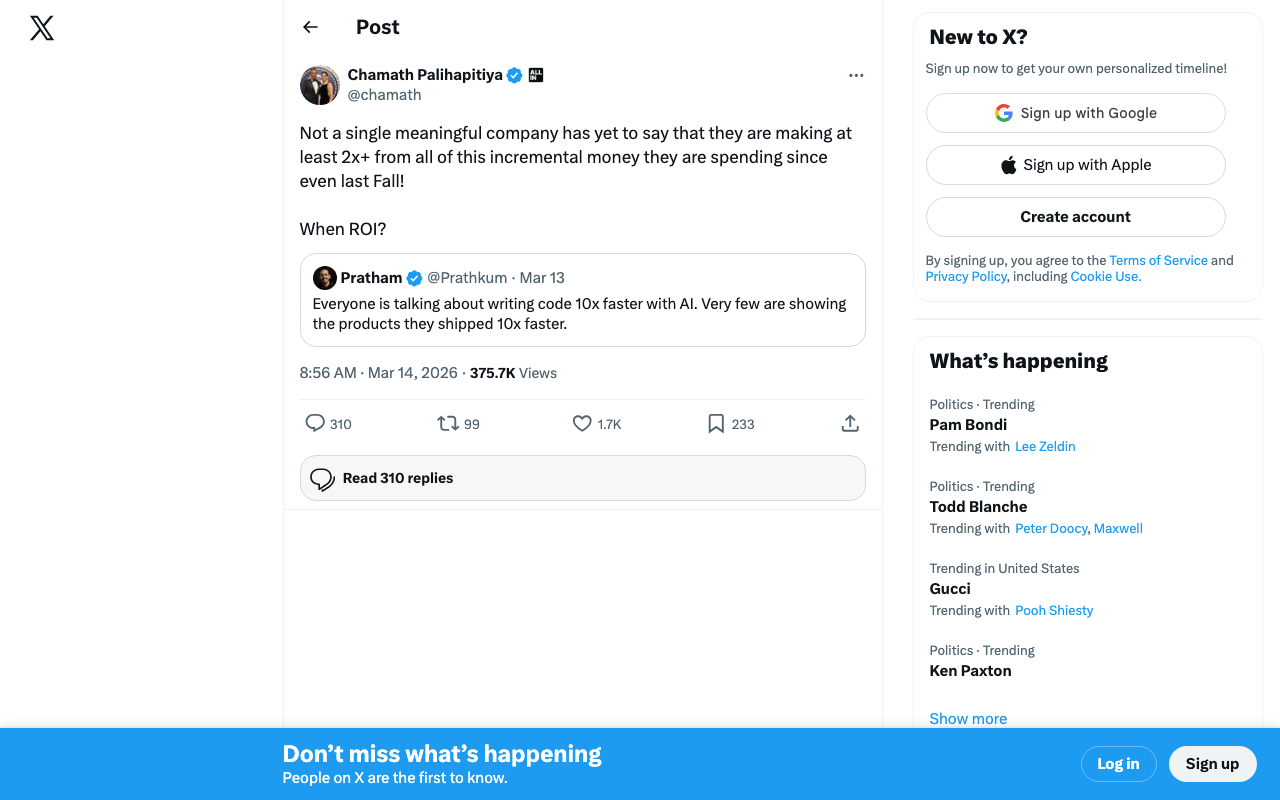
Whether AI is the genuine cause or the convenient cover, the restructuring is real. The jobs are gone. The question isn't whether this is happening — it's what you do about it.
Owen Jennings said: "We are not writing code by hand anymore. That's over."
52,000 tech workers found out this quarter that he wasn't exaggerating.
The question is what you're building while the ground shifts.
Sources: Reuters, CNBC, The Guardian, NYT, Forbes, Fortune, Challenger Gray & Christmas Q1 2026 report, Dallas Federal Reserve, Gartner, Anthropic 2026 Agentic Coding Trends Report, Deloitte 2026 Global Software Industry Outlook, Harvard JOLT, IEEE Spectrum, Stanford/ADP employment data, a16z interview with Owen Jennings, All-In Podcast, Peter Diamandis Abundance360 Summit. Full source links throughout article.
About ComputeLeap Team
The ComputeLeap editorial team covers AI tools, agents, and products — helping readers discover and use artificial intelligence to work smarter.
💬 Join the Discussion
Have thoughts on this article? Discuss it on your favorite platform:
Related Articles
Three Humanoid Robots Just Quietly Cracked Their Records
Figure ran 30h non-stop. Unitree shipped a piloted mecha. A humanoid broke the half-marathon record. One week. The pattern is not coincidence.
Anthropic's Six-Surface Distribution Day
Capital, partnership, SMB product, agent capability, monetization, and prediction-market dominance — six independent surfaces moved together in one cycle.
Meta Incognito Chat: Private Inference as Consumer Wedge
Meta's Incognito Chat puts TEE-attested private inference behind a 2B-user WhatsApp distribution. Here's the wedge math against ChatGPT and Claude.
The ComputeLeap Weekly
Get a weekly digest of the best AI infra writing — Claude Code, agent frameworks, deployment patterns. No fluff.
Weekly. Unsubscribe anytime.