Claude Managed Agents: Build AI Agents Without Writing Code
Anthropic just launched Claude Managed Agents. Here's what it actually does, how it differs from Claude Code, and what you can build with it today.
ComputeLeap Team
Claude Managed Agents: Build AI Agents Without Writing Code
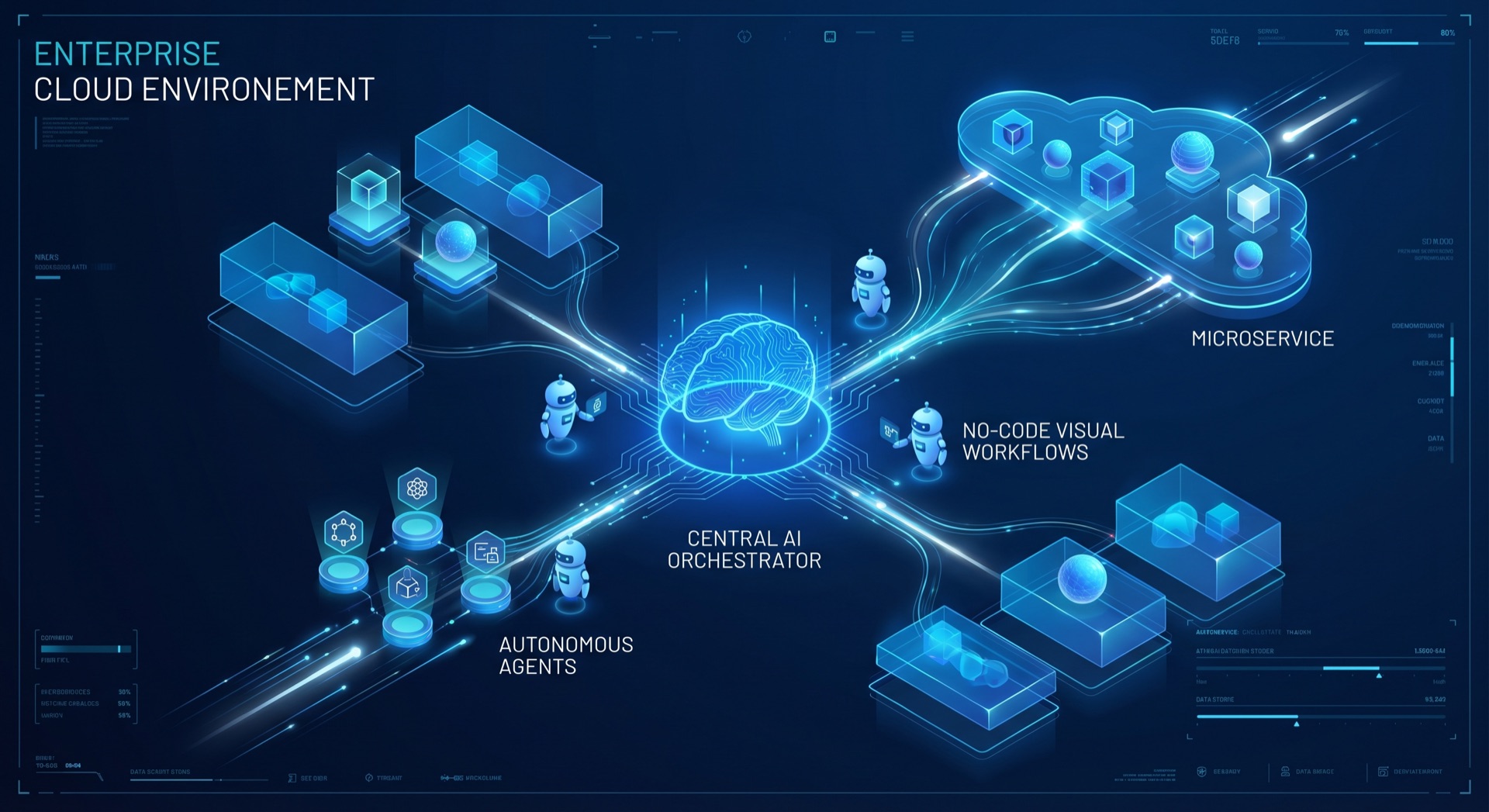
Anthropic launched Claude Managed Agents on April 8, 2026 — and the coverage so far has mostly been "wow, no-code agents." That's the wrong take. Here's what's actually happening, why it matters, and what the scaffolding problem it solves tells you about where the agent economy is going.
The real story: until now, building a production-grade AI agent meant writing your own infrastructure. Containers, state management, credential vaults, error recovery, observability — all before writing a single line of agent logic. Claude Managed Agents eliminates that entire layer. It's not that you can't code. It's that you no longer have to.
TL;DR: Claude Managed Agents is Anthropic's managed infrastructure for AI agents — like AWS but for agentic workflows. You define the agent, Anthropic runs the containers, manages state, handles credentials, and orchestrates tool calls. Enterprise early adopters include Notion, Rakuten, and Asana. Pricing: $0.08/session-hour + standard token costs.
What You Actually Get
Claude Managed Agents is a suite of composable APIs. You define your agent — either in natural language or as a YAML config — and Anthropic handles everything else:
Sandboxed container management. Every agent session gets an isolated cloud container. A web design agent gets a browser. A code agent gets a runtime. You don't configure any of this.
State management. The hard part of production agents isn't the LLM call — it's persisting state across steps. What web pages did the agent visit? Which credentials did it use? What's the checkpoint if a step fails? Managed Agents handles all of it automatically.
Credential vaulting. Agents routinely need access to private systems: cloud tools, databases, APIs. Managed Agents scopes and stores credentials securely without you building a secrets layer.
Tool orchestration. The platform determines which tools the agent should call at each step. When tools fail, the agent retries and recovers without session loss.
Multi-agent delegation (research preview): Agents can spawn and coordinate sub-agents, enabling parallel workstreams within a single workflow.
Auto prompt refinement (research preview): Anthropic claims this improved task success by up to 10 points in internal testing — the system iterates on agent instructions to improve reliability.
Tommy Chryst demoed a full invoice tracking agent live within hours of launch — credential vaults, Slack notifications, approval flows — without writing orchestration code. The demo landed 1.5 hours after launch, which tells you how fast this is to ship with.
How It Differs from Claude Code
The key distinction: Claude Code runs locally and you control the execution environment. Claude Managed Agents runs in Anthropic's cloud and Anthropic controls the execution environment. This is a fundamental architectural difference, not a feature toggle.
Claude Code is a coding agent that lives in your terminal. It reads your codebase, writes code, runs tests, and commits. You're the orchestrator — you decide when it runs, what it touches, how it connects to your systems.
Claude Managed Agents flips that model. Anthropic becomes the orchestrator. Your agent runs on their infrastructure, on their schedule, with their state management. You define the logic; they execute it.
This is the difference between hiring a contractor (Claude Code: you manage their environment, their tools, their access) and using a SaaS platform (Managed Agents: you configure the workflow, the platform handles operations).
When to use Claude Code:
- Working with your local codebase
- Deep integration with your dev environment
- Tasks that need full filesystem access
- You want to own the execution environment
When to use Managed Agents:
- Building production-facing automations
- Agents that run on schedules or triggers
- Workflows that need persistent state across hours
- You don't want to maintain infrastructure
The Zapier integration Rob The AI Guy covered — connecting Claude Code and OpenClaw to 9,000+ apps for free via the Zapier SDK beta — slots neatly into the Managed Agents model. The integration layer is there; Managed Agents gives you the hosted runtime to run it.
What You Can Build Today
The most natural use cases from the early adopter cohort:
Invoice processing and AP workflows — the Tommy Chryst demo was a full invoice tracker: extract data from PDFs, validate against PO records, flag discrepancies, route for approval via Slack, update the ERP. All without custom orchestration code.
Customer support automation — Notion is an early adopter. The pattern: agent reads a support ticket, retrieves relevant docs, drafts a response, escalates if confidence is low.
Data pipeline agents — Rakuten pattern: agents that run on triggers, pull from APIs, transform data, write to target systems. State management is the critical capability here — without it, you rebuild the pipeline from scratch on every failure.
Document processing — extract, classify, route, archive. Asana's use case sits in this category: agents that parse project documents and update task statuses automatically.
The Open-Source Counter-Move
The moment Anthropic announced Managed Agents, the open-source community had an answer: multica-ai/multica, 4,100+ GitHub stars and growing, describes itself as "The open-source managed agents platform. Turn coding agents into real teammates — assign tasks, track."
The comparison to obra/superpowers (143,000+ stars) is instructive. Superpowers is the dominant open-source skills/agents framework — it does what Managed Agents does for the self-hosted crowd. The market has clearly been waiting for this abstraction layer. Anthropic is offering the managed version; multica is offering the self-hosted version.
The HN thread on launch drew 167 points and 84 comments, with the most interesting discussion around a distinction that Anthropic's marketing glosses over: the difference between agents that genuinely operate autonomously and agents that chain API calls with a human-in-the-loop at each step.

Most production agents today sit somewhere on that spectrum. Managed Agents doesn't change that — it just makes the infrastructure to deploy either kind significantly cheaper to build.
Greg Isenberg's framing in his explainer on how Claude agents and skills work is the most useful mental model: skills are verbs (things the agent can do), agents are nouns (persistent systems that use those verbs). Managed Agents is the runtime environment that keeps the noun alive between verb executions.
The Contrarian Take: What This Isn't
Here's what Managed Agents doesn't solve, and what the 10x-faster narrative obscures:
The hard problem isn't infrastructure — it's prompting. Every developer who has shipped a production agent has discovered that the infrastructure takes days to set up and the prompt engineering takes months to get right. Managed Agents eliminates the infrastructure days. It does nothing for the prompt months.
$0.08/session-hour is cheap until your agent runs 24/7. At 720 hours/month, that's $57.60 in session fees plus standard token costs. For a single always-on agent running Opus 4.6, you're looking at hundreds of dollars a month before you process a single real workload. The economics only make sense if the agent replaces a workflow that was costing more.
The research-preview features are the real product. Auto prompt refinement and multi-agent delegation are both in research preview. The current GA product is essentially "we manage your containers and state." Useful — but the 10-point task success improvement from auto prompt refinement is what actually changes the reliability curve for production agents.
What This Means for Practitioners
If you're building agents today without Managed Agents, you're paying a tax in engineering time. The infrastructure Anthropic is abstracting away — containers, checkpointing, credential management, error recovery — takes a team roughly 2-4 weeks to build correctly and months to maintain. At $0.08/session-hour, Managed Agents is almost certainly cheaper than engineering time, for any non-trivial use case.
The Zapier SDK integration is the other unlock worth watching. When you combine managed cloud execution with 9,000 app integrations, you've effectively replaced n8n or Make.com for agentic workflows — without the visual workflow editor and without the per-task pricing model. That's a different value proposition than Anthropic is explicitly marketing, but it's the one that will move enterprise buyers.
For teams already on Claude Code for local development work, Managed Agents is a natural complement rather than a replacement. The play is: use Claude Code for iterative dev work in your local environment, use Managed Agents to deploy the resulting automations into production. Claude Code builds the agent; Managed Agents runs it.
What's Coming
Anthropic's stated direction: more enterprise controls (audit logs, SLA guarantees, private cloud deployment), expanded tool ecosystem, and graduation of multi-agent delegation and auto prompt refinement from research preview to GA.
The bigger bet: Anthropic wants to be the infrastructure layer for the agent economy the same way AWS became the infrastructure layer for web apps. Managed Agents is the first serious attempt at that position.
Whether they get there depends on execution — and on whether the research-preview features that actually differentiate this product graduate quickly enough. If auto prompt refinement ships as GA in Q2 and delivers the 10-point task success improvement at scale, this product gets very interesting very fast.
If the features stay in preview while multica and superpowers continue to compound open-source star counts, the window for Anthropic's infrastructure moat narrows considerably.
Cost reality check: At $0.08/session-hour, a single always-on agent costs ~$57/month in session fees. Add Opus 4.6 token costs for real workloads and you're looking at hundreds per month per agent. The math works when you're replacing manual workflows — not when you're adding automations on top of existing processes.
How to Start
Claude Managed Agents is available in public beta now.
- Access it through the Anthropic Console under Managed Agents
- Define your agent in natural language or YAML
- Configure tool access and credential scopes
- Deploy and test — Tommy Chryst's invoice tracker tutorial above is the fastest path to your first working agent
Pricing: $0.08/session-hour active runtime plus standard Claude API token rates. Notion, Rakuten, and Asana are already in production. The beta is open.
Sources: Anthropic Blog · Anthropic Docs · SiliconAngle · TechRadar · The New Stack · InfoWorld · The Decoder · Tommy Chryst demo · Rob The AI Guy / Zapier SDK · Greg Isenberg explainer · HN thread · multica-ai/multica
ComputeLeap Team
The ComputeLeap editorial team covers AI tools, agents, and products — helping readers discover and use artificial intelligence to work smarter.
Join the discussion
Have thoughts on this article? Discuss it on your favorite platform:
Related articles
Run GLM-5.2 Locally: The Open Model Nobody Can Ban
GLM-5.2 ships 744B params under MIT license. Here's the hardware you need, the quant that fits, and the setup for llama.cpp, Ollama, and LM Studio.
DeepSeek-TUI Setup Guide: Rust Coding Agent on V4 Flash
Install DeepSeek-TUI, configure V4 Flash, run your first session, and decide when to use it vs Claude Code or cc-switch routing.
Cut Claude Code Token Costs 60-90% With rtk: Hands-On Guide
Stop dumping raw terminal output into Claude Code's context. rtk is a Rust CLI proxy that filters git, cargo, and npm output for 60-90% savings.