OpenAI Killed the Codex Model Line: What It Means for Devs
OpenAI confirms there's no GPT-5.5-Codex. Here's what changes for devs who built around the Codex tier — and where third-party skills fill the gap.
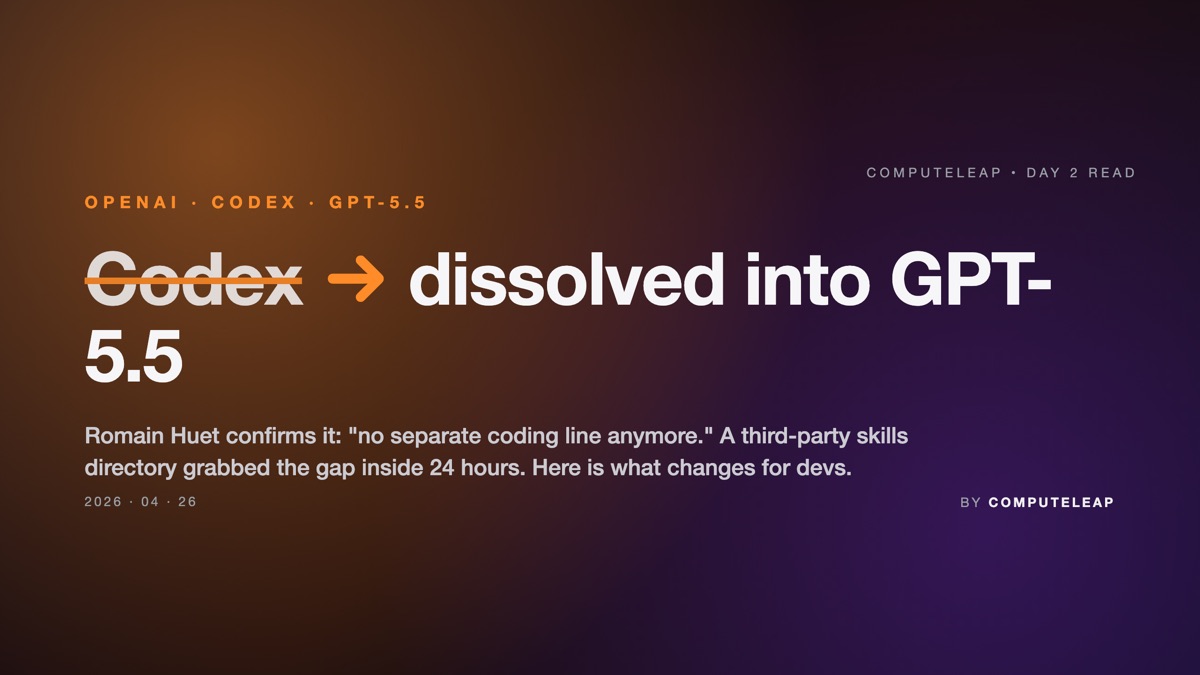
For the last three years, "Codex" was a parallel model line at OpenAI — a coding-specialized branch you could route to with gpt-5-codex, gpt-5.2-codex, gpt-5.3-codex SKUs. As of this week, it's gone. Not deprecated, not paused. Collapsed into the general-purpose tier and not coming back as a separate model.
The confirmation came from Romain Huet, OpenAI's Head of Developer Experience, in a reply that Simon Willison flagged on April 25:

"Since GPT-5.4, we've unified Codex and the main model into a single system, so there's no separate coding line anymore. GPT-5.5 takes this further, with strong gains in agentic coding, computer use, and any task on a computer."
Willison's framing is sharper than the official one: "OpenAI won't release a GPT-5.5-Codex model." The Codex product — the CLI, the cloud agent, the IDE extension — is alive and shipping. The Codex model line is not. And that distinction is the whole story.
If you're a developer who built infrastructure against gpt-5-codex-* model IDs, treated Codex as the high-end coding tier of the API, or designed your billing around a specialized coding endpoint — you have homework this week. Here's what actually changed, what didn't, and where the third-party ecosystem is already filling the gaps OpenAI just opened.
What Actually Died: The Model Line, Not The Product
The naming around "Codex" has been confused since OpenAI revived the brand in 2024 and slapped it onto a CLI, a cloud agent, and a model variant. Three different things, one word. The collapse only kills one of them.
What's gone:
- The dedicated Codex model variants. GPT-5.3-Codex, shipped in early February, was the last standalone Codex model. From GPT-5.4 onward, there is one frontier model that handles both general tasks and coding. Huet confirmed this directly. The Codex page in OpenAI's developer docs still lists historical SKUs, but no new branched model is planned.
- The premium "coding-tier" billing rationale. OpenAI is no longer differentiating coding capability at the model layer, which means there's no obvious basis for charging a coding premium. Pricing follows GPT-5.5 / GPT-5.5 Pro tiers.
- The "specialized model for hard coding tasks" framing. OpenAI now claims the general model is the best coding model. This is a strategic bet — not a graceful sunset.
What survives:
- The Codex CLI. openai/codex on GitHub is alive (78K stars, +195 today as of this writing) and is now the canonical front end to GPT-5.5's agentic capabilities.
- Codex Cloud, the IDE extension, and the auto-review subagent. These are product surfaces, not models.
- The Codex skills mechanism — instruction bundles loaded into the agent at runtime, the architectural pattern Composio is now indexing (see Section 3).
The Decoder put it bluntly: OpenAI has effectively retired the dedicated 'Codex' brand at the model layer; the product brand survives, the separate model line does not. If you only read marketing copy you'd think Codex got an upgrade. If you read the API docs, you see the family tree end at 5.3.
The HN community has been working through what this means in real time:

The New Prompting Conventions: GPT-5.5 Is Not a Drop-In
If you carried over your GPT-5.3-Codex prompts, expect regressions. OpenAI shipped a fresh GPT-5.5 prompting guide, and Willison's annotated read of it calls out the change that matters most for agent builders.

Convention #1 — Send a short user-visible status update before tool calls. OpenAI's recommendation, in Willison's words: keep it to one or two sentences, acknowledge the request, state the first step. The result, he notes, "does make longer running tasks feel less like the model has crashed." The Codex app already does this. The pattern is now official.
The implication for your code: if your agent harness suppresses model output between tool calls (a common optimization), you're now fighting the model. Let the status update through. Treat it as a UX feature, not a debug log.
Convention #2 — Tune from minimum, don't carry over. The OpenAI recommendation is explicit: start with the minimal prompt that preserves your product's contract, then systematically tune reasoning effort, verbosity, tool descriptions, and output format against representative examples. Don't paste in your old GPT-5.3-Codex system prompt and assume it works.
Convention #3 — Use AGENTS.md. Codex CLI now reads AGENTS.md files in the project tree as steering documents. This isn't unique to GPT-5.5 — it borrows the convention Anthropic popularized with CLAUDE.md and the broader agent ecosystem normalized this year. But it's now the recommended mechanism for project-specific context. If you've been stuffing project context into your system prompt, move it to AGENTS.md.
Convention #4 — Reasoning is a dial, not a switch. GPT-5.5 exposes reasoning effort as a tunable parameter. The Codex TUI even bound it to keys (Alt+, lowers, Alt+. raises). Your agent harness should expose this, not pin it.
The Skills Gap: Composio Just Landed The Codex Slot
Here's the part that matters strategically: OpenAI did not ship an official Codex skills directory. They shipped the mechanism — agents loading SKILL.md instruction bundles at runtime — but no curated index. Within 24 hours of the GPT-5.5 launch, ComposioHQ/awesome-codex-skills appeared on GitHub trending as a NEW ENTRANT. It hit 2,100 stars, 161 forks, and 20 open PRs in its first day. There's now an outside organization staking the canonical position before OpenAI built one themselves.
The repo describes itself as "a curated list of practical Codex skills for automating workflows across the Codex CLI and API." The categories are exactly what you'd expect a first-party OpenAI directory to cover:
- Development & Code Tools —
gh-fix-ci(inspect failing GitHub Actions, propose fixes),pr-review-ci-fix(automated PR review + CI auto-fix loop) - Productivity & Collaboration —
meeting-notes-and-actions,notion-research-documentation - Communication & Writing
- Data & Analysis —
spreadsheet-formula-helper - Meta & Utilities
The pattern matters because it's the same shape as mattpocock/skills, the canonical Claude Code creator skills directory that just tripled momentum to 22.5K stars (+2,507 in a single day). One creator-led directory for Claude. One organization-led directory for Codex. Both filling the same architectural slot — cross-vendor discoverability for runtime-loaded skill bundles — which neither OpenAI nor Anthropic provides as a first-party service.
This is not a minor ecosystem footnote. The skills directory is the first place a builder looks when adopting an agent platform. Whoever owns that directory shapes which skills get composed, which patterns become idiomatic, and which integrations get the network effect. By absenting itself, OpenAI handed that surface to Composio for the Codex side and to mattpocock for the Claude side.
awesome-* lists historically. Watch which OpenAI picks — it tells you whether they actually intend to compete in skill curation or treat it as outside their scope.Migration Checklist: What To Change This Week
If you shipped against any Codex-branded model SKU, here's the practical punch list. Most teams can finish this in an afternoon.
1. Audit your model routing. Grep your codebase and config for gpt-5-codex, gpt-5.2-codex, gpt-5.3-codex. Each match is a future 404 the moment OpenAI stops serving the deprecated SKU. Replace with gpt-5.5 (or gpt-5.5-pro for harder tasks) per the Codex models page. Side note: the GPT-5.5 launch brought a 1M-token context window — your existing chunking might be doing more work than it needs to.
2. Re-tune your prompts from minimum. Don't carry over GPT-5.3-Codex system prompts wholesale. Strip to minimum, add the status-update convention, layer back complexity only when an eval regresses.
3. Move project context to AGENTS.md. If you used the Codex CLI or Codex Cloud, project-specific instructions belong in AGENTS.md files in the repo, not in a global system prompt.
4. Expose reasoning as a parameter. If your agent harness pins reasoning effort, unpin it. GPT-5.5 rewards giving callers the ability to dial up for hard tasks and down for cheap ones.
5. Inventory your skills. If you wrote Codex skills, audit them against the Composio repo's category structure. The skills that overlap with gh-fix-ci or meeting-notes-and-actions may already have a better community version. The skills that don't overlap are candidates for upstream contribution — open a PR.
6. Recheck your benchmarks. If you're still reporting SWE-bench Verified scores in your eval suite, OpenAI's own retirement post is the receipt to update:

The HN thread (260 points, 147 comments) absorbed the retirement as overdue benchmark hygiene rather than a flex. SWE-bench co-creator ofirpress notes the benchmark is now saturated at 93.9%; commenter energy123 raises whether prior leaderboard wins came through "shady means" given that 59% of audited failures had defective tests. Move to SWE-bench Pro or your own held-out eval. The leaderboard you're chasing is contaminated.
7. Watch the superapp surface. TechCrunch's framing calls GPT-5.5 "a step toward a unified 'superapp' combining ChatGPT, Codex, and an AI browser." Latent Space's read goes further: "OpenAI seems to have made the critical and retroactively obvious choice to turn Codex into the base of its superapp strategy." If your product overlaps with browser control, Sheets/Slides, Docs/PDFs, or OS-wide dictation, the platform now competes with you directly. Plan accordingly.
What The Codex Collapse Signals About OpenAI
Step back. Two things happened on the same day. (1) OpenAI killed the Codex model line by folding it into GPT-5.5. (2) OpenAI publicly retired SWE-bench Verified as the coding benchmark — replacing it with SWE-bench Pro and signaling that they'll work with the industry on stronger evals. NVIDIA confirmed that GPT-5.5 was co-designed for GB200/300 systems and that the model itself helped improve its own inference stack.
The pattern: OpenAI is consolidating its frontier into one model, one benchmark family, one inference stack, and one product surface (the superapp). The "specialized branch" architecture — Codex over here, general model over there, separate evals, separate teams — is being collapsed into a single vertical.
That's a strategic answer to two pressures. First, the Anthropic/Claude Code ecosystem is compounding faster than OpenAI's, and a unified model is easier to compete from than a fork. Second, the superapp thesis (one model under everything) only works if there isn't a "specialty" model to maintain in parallel. Killing Codex-the-model isn't a step backward; it's clearing room for the unification.
The cost is what we've been documenting in this post: a confused brand (Codex-the-product on top of GPT-5.5-the-model), a developer migration tax (everyone updating SKUs and prompts), and a strategic gap in skill curation that Composio just walked into. None of those costs are fatal. All of them are the kind of thing that benefits the competing ecosystem more than it benefits OpenAI.
The Practical Takeaway
If your team uses Codex in any form, the action items are unambiguous: update model SKUs, re-tune prompts from minimum, adopt the status-update convention, move context to AGENTS.md, and audit your skills against the Composio directory. Treat the migration as a forcing function to clean up cargo-culted prompts.
If you're an agent builder evaluating platforms right now, the answer is more interesting. Two of the three frontier vendors (OpenAI and Anthropic) now ship runtime-loadable skill bundles as a primary affordance, and neither owns the curation layer. That layer is the next category-defining race — and as the DeepSeek V4 vs GPT-5.5 vs Claude Opus 4.7 comparison showed, model quality is converging fast enough that the platform with the best ecosystem layer wins.
The Codex model line is dead. The ecosystem fight just got interesting.
About ComputeLeap Team
The ComputeLeap editorial team covers AI tools, agents, and products — helping readers discover and use artificial intelligence to work smarter.
💬 Join the Discussion
Have thoughts on this article? Discuss it on your favorite platform:
Related Articles
DeepSeek V4 vs GPT-5.5 vs Claude Opus 4.7: Model Guide
DeepSeek V4 dropped today with 1M context at 1/6th the cost. Here's how it stacks up against GPT-5.5 and Claude Opus 4.7 for developers.
GPT-5.5 vs Claude Code: Which AI Should You Use?
GPT-5.5 launched today with agentic-first positioning. We benchmark it head-to-head against Claude Code across solo dev, team, and enterprise setups.
Kimi K2.6 vs Claude Opus 4.7: The 88% Cost Advantage
Moonshot AI's Kimi K2.6 matches Claude Opus 4.7 on coding benchmarks at $0.60/M tokens vs $5.00/M. A developer's honest guide to when it's worth the switch.
The ComputeLeap Weekly
Get a weekly digest of the best AI infra writing — Claude Code, agent frameworks, deployment patterns. No fluff.
Weekly. Unsubscribe anytime.